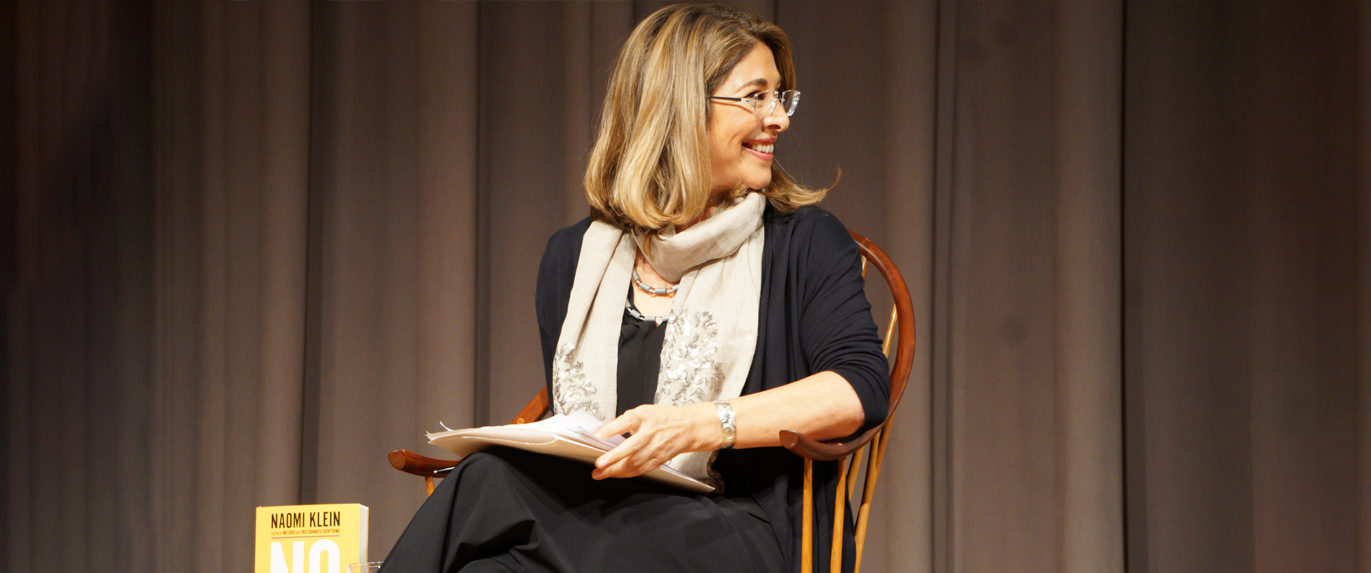
Naomi Klein

The Shock Doctrine
The Rise of Disaster Capitalism
"Klein may well have revealed the master narrative of our time."
-San Francisco Chronicle
Around the world in Britain, the United States, Asia and the Middle East, there are people with power who are cashing in on chaos; exploiting bloodshed and catastrophe to brutally remake our world in their image. They are the shock doctors. Thrilling and revelatory, The Shock Doctrine cracks open the secret history of our era. Exposing these global profiteers, Naomi Klein discovered information and connections that shocked even her about how comprehensively the shock doctors' beliefs now dominate our world - and how this domination has been achieved. Raking in billions out of the tsunami, plundering Russia, exploiting Iraq - this is the chilling tale of how a few are making a killing while more are getting killed.
Read More at ShockDoctrine.com.
The Shock Doctrine Short Film, Coming Soon
Tour Dates
Check back soon for extensive Fall speaking tour dates.

The Shock Doctrine Short Film


For more information and to watch or download higher quality versions of the short film, go to the Shock Doctrine Short Film page.

Recent Articles

Disaster Capitalism: State of Extortion

Once oil passed $140 a barrel, even the most rabidly right-wing media hosts had to prove their populist cred by devoting a portion of every show to bashing Big Oil. Some have gone so far as to invite me on for a friendly chat about an insidious new phenomenon: "disaster capitalism." It usually goes well--until it doesn't.

For instance, "independent conservative" radio host Jerry Doyle and I were having a perfectly amiable conversation about sleazy insurance companies and inept politicians when this happened: "I think I have a quick way to bring the prices down," Doyle announced. "We've invested $650 billion to liberate a nation of 25 million people. Shouldn't we just demand that they give us oil? There should be tankers after tankers backed up like a traffic jam getting into the Lincoln Tunnel, the Stinkin' Lincoln, at rush hour with thank-you notes from the Iraqi government.... Why don't we just take the oil? We've invested it liberating a country. I can have the problem solved of gas prices coming down in ten days, not ten years."

There were a couple of problems with Doyle's plan, of course. The first was that he was describing the biggest stickup in world history. The second, that he was too late: "We" are already heisting Iraq's oil, or at least are on the cusp of doing so.

Read the rest of the article

Obama's Chicago Boys

Barack Obama waited just three days after Hillary Clinton pulled out of the race to declare, on CNBC, "Look. I am a pro-growth, free-market guy. I love the market."

Demonstrating that this is no mere spring fling, he has appointed 37-year-old Jason Furman to head his economic policy team. Furman is one of Wal-Mart's most prominent defenders, anointing the company a "progressive success story." On the campaign trail, Obama blasted Clinton for sitting on the Wal-Mart board and pledged, "I won't shop there." For Furman, however, it's Wal-Mart's critics who are the real threat: the "efforts to get Wal-Mart to raise its wages and benefits" are creating "collateral damage" that is "way too enormous and damaging to working people and the economy more broadly for me to sit by idly and sing 'Kum-Ba-Ya' in the interests of progressive harmony."

Obama's love of markets and his desire for "change" are not inherently incompatible. "The market has gotten out of balance," he says, and it most certainly has. Many trace this profound imbalance back to the ideas of Milton Friedman, who launched a counterrevolution against the New Deal from his perch at the University of Chicago economics department. And here there are more problems, because Obama--who taught law at the University of Chicago for a decade--is thoroughly embedded in the mind-set known as the Chicago School.

Read the rest of the article

See the University of Chicago faculty's letter about the Milton Friedman Institute.


Regime-Quakes in Burma and China

When news arrived of the catastrophic earthquake in Sichuan, my mind turned to Zheng Sun Man, an up-and-coming security executive I met on a recent trip to China. Zheng heads Aebell Electrical Technology, a Guangzhou-based company that makes surveillance cameras and public address systems and sells them to the government.

Zheng, a 28-year-old MBA with a text-messaging addiction, was determined to persuade me that his cameras and speakers are not being used against pro-democracy activists or factory organizers. They are for managing natural disasters, Zheng explained, pointing to the freak snowstorms before Lunar New Year. During the crisis, the government "was able to use the feed from the railway cameras to communicate how to deal with the situation and organize an evacuation. We saw how the central government can command from the north emergencies in the south."


China's All-Seeing Eye

Published in Rolling Stone

With the help of U.S. defense contractors, China is building the prototype for a high-tech police state. It is ready for export.

Thirty years ago, the city of Shenzhen didn't exist. Back in those days, it was a string of small fishing villages and collectively run rice paddies, a place of rutted dirt roads and traditional temples. That was before the Communist Party chose it — thanks to its location close to Hong Kong's port — to be China's first "special economic zone," one of only four areas where capitalism would be permitted on a trial basis. The theory behind the experiment was that the "real" China would keep its socialist soul intact while profiting from the private-sector jobs and industrial development created in Shenzhen. The result was a city of pure commerce, undiluted by history or rooted culture — the crack cocaine of capitalism. It was a force so addictive to investors that the Shenzhen experiment quickly expanded, swallowing not just the surrounding Pearl River Delta, which now houses roughly 100,000 factories, but much of the rest of the country as well. Today, Shenzhen is a city of 12.4 million people, and there is a good chance that at least half of everything you own was made here: iPods, laptops, sneakers, flatscreen TVs, cellphones, jeans, maybe your desk chair, possibly your car and almost certainly your printer.

Financial Times Diary: Smoke and Memories in Buenos Aires

We are circling over Buenos Aires. The airspace is crowded with other planes, all of them holding like ours. The pilot explains that it is the fault of the humo, or smoke, a word I will hear a great deal in the coming week.

An hour and a half later I am on the ground, head pounding, breathing in the humo. The cover of the Clarín newspaper shows someone gagging and declares: "The Worst Atmospheric Contamination in History."

Some things, such as slight overstatement, haven't changed in Buenos Aires. Still, it's hard not to think of the first time I came here. It was January 2002. The economy had just crashed, the banks had locked out their customers and Argentines had thrown out five presidents in three weeks. There was smoke in the air then, too, but it was from the bonfires in the streets.
More About No Logo

More About Fences and Windows

Click Here to subscribe to
Naomi Klein's Newsletter.

The Take: A Film by Avi Lewis & Naomi Klein
A Film by
Avi Lewis & Naomi Klein

Featured Activist Campaign
Hands Off Iraqi Oil

Hands Off Iraqi Oil